FEATURED |
By George B. Sánchez-Tello
On the evening of Oct. 26, members of the public suspected immigration agents were outside Monterey County Jail. People were already on edge — just the day before, two people were detained in Seaside in a targeted arrest, part of a recent rise in attempted ICE detentions there.
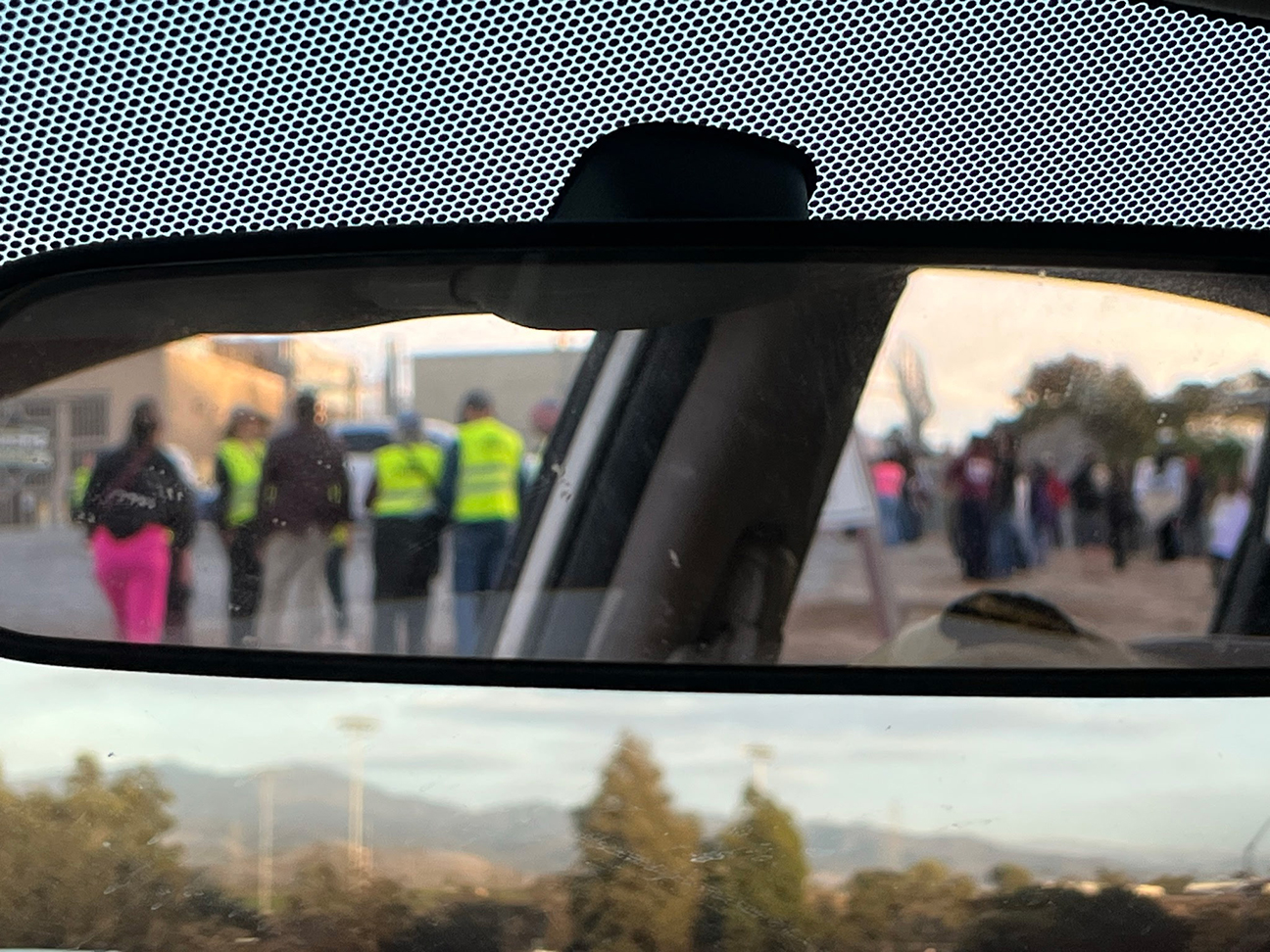
The next morning, about 20 volunteer legal observers arrived outside the county jail, visible alongside demonstrators, protestors and even Monterey County supervisors.
While the observers’ appearance was their most recent, it wasn’t the first time they were called to action.
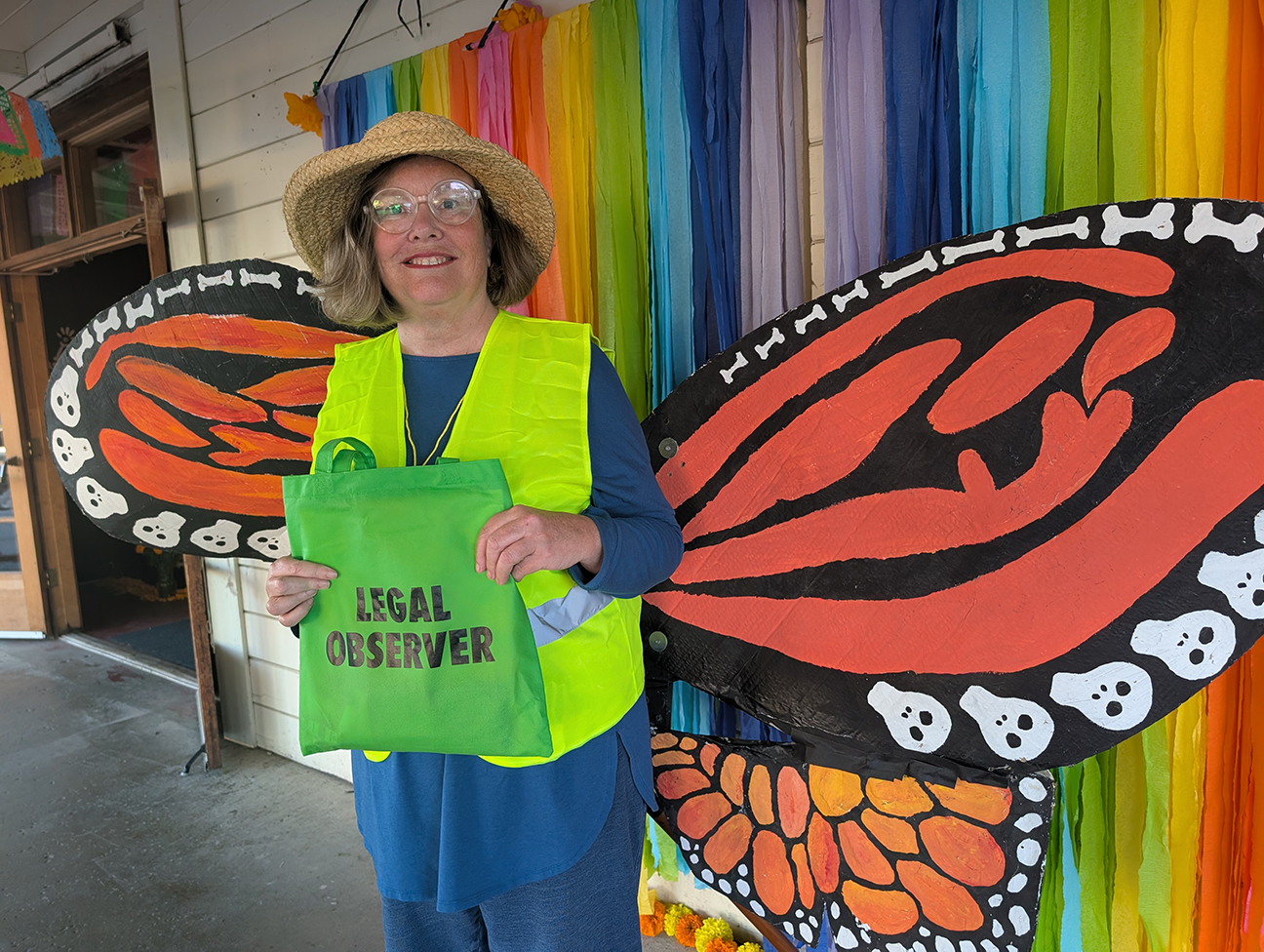
Last November, El Teatro Campesino sought out legal observers at its annual Día de Los Muertos event in San Juan Bautista. This spring, observers were requested for a rural march against a proposed detention facility in Gilroy.
And so, from the Monterey Peninsula they came: the Subaru Squad and the White People’s Army — silly nicknames the Gilroy organizers gave the legal observers who volunteered their presence.
Some of the volunteers — mainly retired white women and men — had questioned if their presence was appropriate, recalls Megan Whilden; then they heard the nicknames and started laughing. The tension eased.
“You make friends,” Whilden said, who was also a candidate for the Monterey County Board of Education (Whilden was trailing Rita Patel as of Wednesday morning, Nov. 4). “I think we should be at more events — that’s better than tabling.”
“A legal observer stays quiet, stays out of the way and films, but if you decide you can't do that, you have to take off your vest that says ‘legal observer’ and you can scream.”
Megan Whilden
Legal observers are a key part of the network of volunteers who assist when residents suspect immigration agents are nearby. Trained to document detentions, much of their work is actually dispelling rumors. While Monterey County has been largely spared from the widespread raids that have rattled Southern California and the San Joaquin Valley, Monterey County’s network of immigrant aid wants to be prepared if ICE escalates beyond targeted and collateral arrests of undocumented residents.
Support for immigrants and immigrant communities amidst raids and detentions in Monterey County has taken various forms. Coalitions have sprung up, like the Solidarity Network Monterey County Response, which includes The Watsonville Law Center, Monterey Bay Central Labor Council, the law offices of Blanca Zarazúa and Magnolia Zárraga and a group called Whites for Racial Equity. Others hosted events, like Indivisible Monterey’s Whistlemania, which gathered volunteers to assemble emergency kits, including whistles, in the event of an immigration raid or detention. Businesses have held fundraisers, like the “Raise a Pint for Immigrants” at Other Brother Beer in Seaside. Foundational to these efforts are unpaid, individual volunteers.
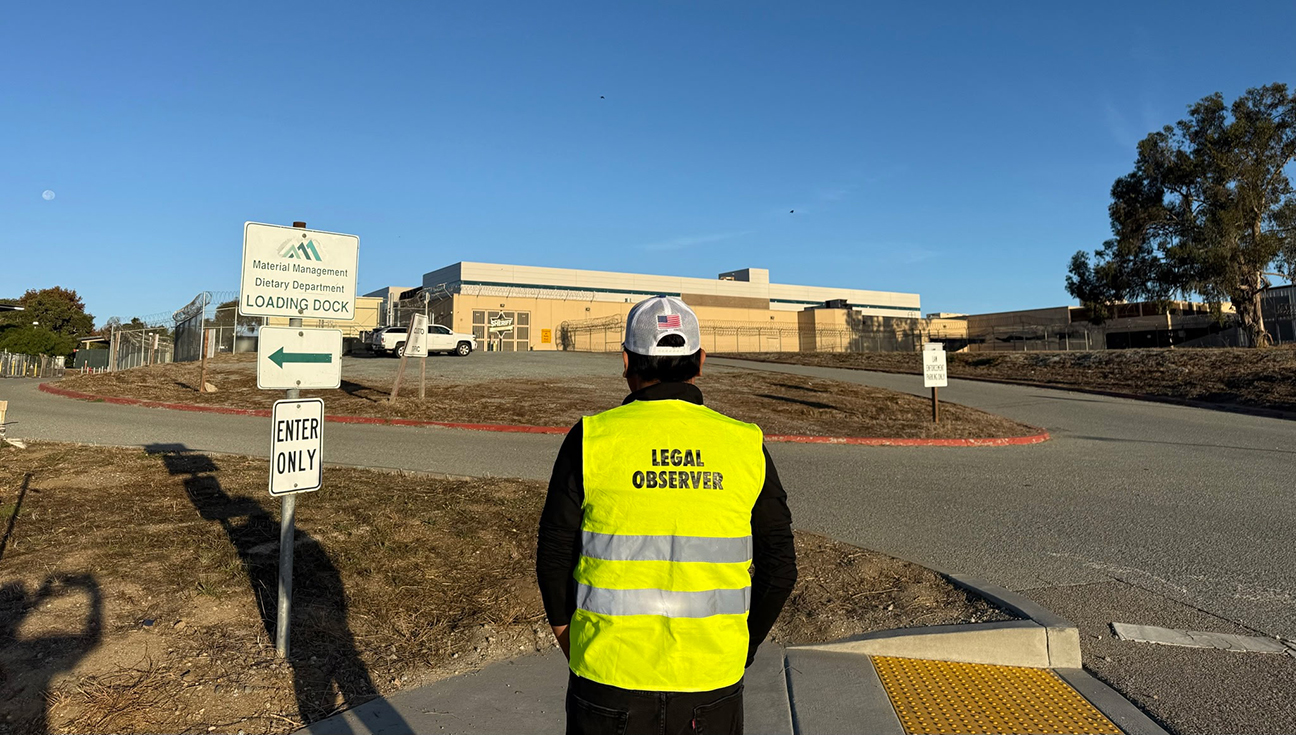
More than 4,000 people have been trained as legal observers for the region. Retired immigration attorney Jack Holmgren explained the work of legal observers as the act of witnessing.
There is an important distinction between whistle and witness, said Holmgren, who trains legal observers. Whistles are a warning tool for targeted and allied communities to raise public alarm before or during a detention or raid, while a witness records and takes notes to document an incident and shares them with attorneys.
“Witness is one of the most powerful things in the world,” Holmgren said. He credits disciplined, passive witnesses and legal observers to bringing the world’s attention to the broad-daylight killing of George Floyd, reigniting the Black Lives Matters movement, and, earlier this year, Stella Carlson’s recording of ICE agents shooting and killing nurse Alex Pretti in Minneapolis.
“She recorded. She didn’t yell. She didn’t blow a whistle,” Holmgren said. “She had the amazing courage to film ICE murdering Alex Pretti in cold blood.”
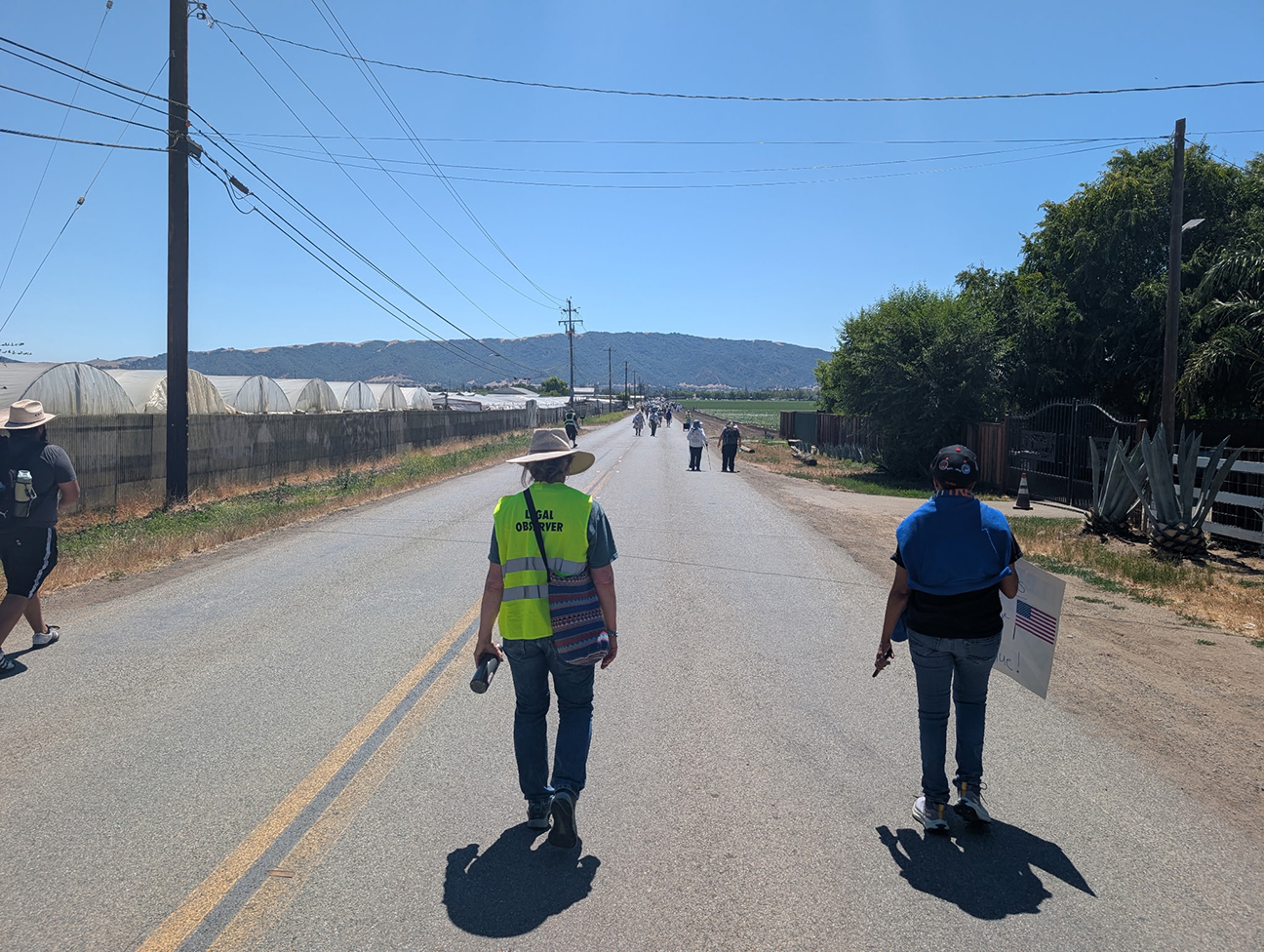
Legal observers “create documentation during events which can later be used in defense cases, public statements, and litigation which aims to hold law enforcement agencies accountable for the actions of their officers,” according to the National Lawyers Guild, whose Legal Observer program was created in 1968 and modeled on the Black Panthers’ armed citizens patrol, which later became known as Copwatch.
Legal observer training in Monterey County lasts approximately two hours and includes role-playing exercises to give volunteers a sense of what they may experience. After, trainees may volunteer to become on-call legal observers.
“She recorded. She didn’t yell. She didn’t blow a whistle,. She had the amazing courage to film ICE murdering Alex Pretti in cold blood.” Jack Holmgren
During the first Trump administration, between 2016-2020, more than 4,000 locals were trained to create an active network of 1,000 legal observers, said Adriana Melgoza, executive director of Watsonville Law Center. Since 2025, more than 1,000 volunteers have been trained, and there is a current network of 400 active legal observers.
One of those volunteers is Megan Whilden.
***
In the summer of 2025, Whilden and others received a text message. Community members contacted the Monterey County Solidarity Network to report multiple black SUVs in the parking lot of a hotel in Seaside and suspicion of ICE agents being present. Whilden was asked to go to the hotel and confirm ICE’s presence. She grabbed her kit: a reflective vest emblazoned with the words “legal observer,” a note pad, pen and her phone to take photos.
When Whilden arrived, she drove around the hotel parking lot and took pictures. Then she called Seaside police to inquire if they were aware of an ICE detention.
“They don’t want people freaking out, either,” Whilden said about local police.
Seaside police offered to check with the Department of Homeland Security. The vehicles and suspected ICE agents turned out to be Fish and Wildlife agents.
“Once we confirmed it was Fish and Wildlife, that was good, because we could send out that notice,” Whilden said.
The confirmation that it was not ICE allowed the Solidarity Network to post to social media, dispel rumors and hopefully refrain the public from panic and fear.
“Here, you can go months without a single call for action. That’s really how it is, but knowing that that could change at any minute,” Whilden said. “Almost always, it’s a false alarm. But those are important to investigate because of the debilitating fear that so many people live under.”
Whilden was born and raised in Monterey before leaving to the East Coast for 30 years, where she worked in local government and art and education nonprofits. She returned to Monterey five years ago to take care of her mother. Her departure was front-page news in the Massachusetts town she left.
“When ICE comes to town, the tourist industry — food, beverage, lodging — the agricultural industry will cease. It will stop. People will not go to work.” Jack Holmgren
Whilden and Holmgren both note that Monterey County has so far been spared the dramatic, at-large raids deployed across Southern California and parts of the Central Valley.
“The $64,000 question is why. Why has Monterey County skated this?,” Holmgren asked. “There was the whole nonsense at Hunter Liggett, but in general, their command structure is not deploying in Monterey County.”
Nonetheless, Whilden said, locals need to be prepared.
“It’s the assumption we need to live with so people are prepared. ‘Well, so far, so good;’ yeah, but what if things change?”
The harm of such raids could be devastating in a region driven by migrant and immigrant labor, Holmgren said.
“When ICE comes to town, the tourist industry — food, beverage, lodging — the agricultural industry will cease. It will stop. People will not go to work. That is the economy of this county,” Holmgren warned. “We’re looking at a disaster of unimaginable proportion.”
If that day comes, Whilden said, legal observers and others need to remain disciplined in their training.
“A legal observer stays quiet, stays out of the way and films, but if you decide you can’t do that, you have to take off your vest that says ‘legal observer’ and you can scream,” Whilden said. “If we go into a surge, choose your lane. If you want to deliver food, you can’t be a legal observer — and you can’t be a screamer.”
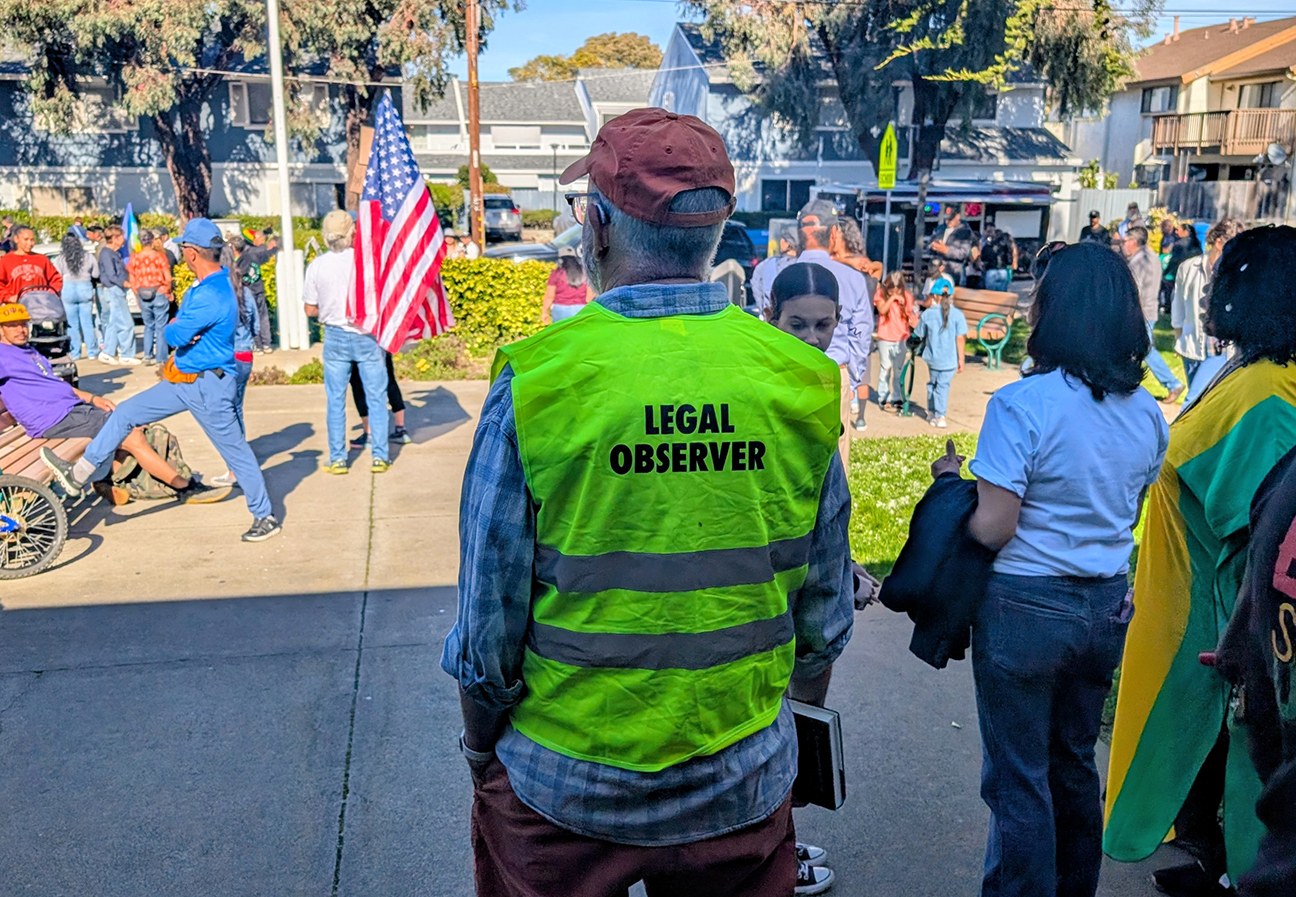
In the meantime, the infrastructure of rapid response and mutual aid needs to be strengthened, both agreed. They note that the Monterey County Solidarity Network’s rapid response line is operated by a few unpaid volunteers 24 hours a day, seven days a week. There is a desire for that to include a paid staff position that could alleviate some of the responsibility for volunteers.
And they agreed there need to be more legal observers in the Salinas Valley, especially in more isolated and rural South County communities like Lockwood and San Ardo. There is a need for bilingual — English and Spanish — as well as multilingual legal observers and volunteers who can engage with the region’s Mexican Indigenous communities.
“The work with the Solidarity Network is very important because it’s a concrete manifestation of us being with immigrants in this horrible struggle and discrimination,” Holmgren said. “Everything that we can do to show our togetherness, our solidarity, our support for the targeted community, is very important, no matter what it is.”
Since Oct. 26, at least two people released by sheriff’s deputies from Monterey County Jail have been detained by immigration officials. Legal observers have maintained a presence there due to the ongoing concerns of ICE agents. And on Nov. 3, legal observers fanned out across the county to monitor voting and polling stations in the event immigration agents arrived or were seen nearby.
The day after the mid-term elections, the observers remained on watch outside county jail.
FEATURED IMAGE |
Enlarge

Have something to say about this story? Send us a letter.
SUPPORT NONPROFIT JOURNALISM 
GET OUR FREE NEWSLETTER