YOUNG VOICES |
Article and photos by Isaac Gonzalez-Diaz
With the Nov. 3 elections approaching, Salinas voters face a high-stakes choice over rent stabilization: whether to preserve renter-protection ordinances approved by a previous council or repeal them.
Measure H asks voters to repeal rent stabilization, tenant protection, just-cause eviction and tenant anti-harassment ordinances. Voting yes would uphold the repeal and end the ordinances, which were approved by the Salinas City Council in 2024.
“If people vote no, that means that the ordinances stay in place so the repeal doesn’t happen.” said Rene Méndez, Salinas city manager. “If people go yes, then the repeal action is affirmed, so the four ordinances stop.”
The four ordinances moved forward by the previous city council on Sept. 24, 2024, and took effect on Jan. 1, 2025. But the current city council voted to end them on April 22, 2025, with a 5-2 vote.
“That impacts low-income renters, and impacts students and impacts community members and even teachers,” said Jesús Valenzuela, former District 3 Salinas councilmember and spokesperson for Protect Salinas Renters.
After the current city council voted to repeal the rent stabilization ordinances, residents received letters from their landlords saying that rent was going to increase 10%, which is the California state limit, Valenzuela said.
With the aim to preserve rent stabilization ordinances and tenant protection, a group of volunteers gathered 10,000 signatures in less than 30 days to put the vote to a referendum and potentially bring the repealed ordinances back into effect. Protect Salinas Renters was able to put the ordinance on the Nov. 3 ballot.
“We started really surveying what the people had to say about their rents,” said John Silva, retired doctor and member of the fundraising and finance committee of Protect Salinas Renters. The survey takers heard “how challenging the rental increases were and also how badly kept up their apartments were,” Silva added.
The four ordinances remain in effect, pending the result of the election. In the meantime, the current city council approved a $750,000 budget for pilot rental assistance to be offered as an alternative to the Rental Stabilization Ordinances.
“We’re still going to have a rental assistance program, so that doesn’t go away,” said Méndez.
On Aug. 28, volunteers with Protect Salinas Renters were trained to canvas their neighborhoods. They visited apartments around Salinas, knocked on doors, talked about rent stabilization and promoted a “no” vote on Measure H. Some residents opened the door and received the message, others didn’t.
A resident who preferred to remain anonymous for fear of retaliation said she had been living at Cypress Creek Apartment Complex for a long time, and that rent stabilization is necessary for the high rates that Salinas renters are paying.
Elvia Aguilar, a resident on North Sanborn Road, said the four ordinances are important because renters didn’t feel listened to by landlords.
“It is important to have tenants’ rights,” said Aguilar, “because we weren’t being taken into account.”
Enlarge
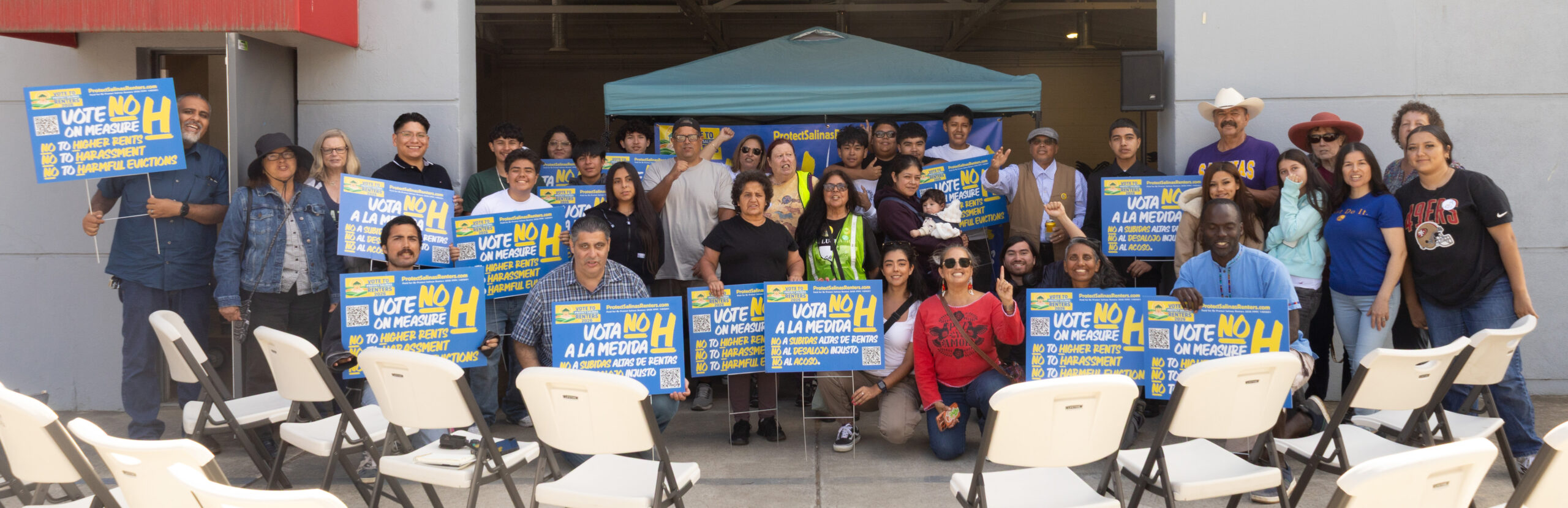
Protect Salinas Renters has received support from several candidates who are running for mayor or city council seats.
“I think that a lot of people are benefiting from having the stability of the rent not going up drastically,” said Daniel Muñoz, who’s running for mayor. “And I think it benefits a large portion of the people in Salinas.”
On the other side of the aisle, opponents of the rent stabilization ordinances are working on a “Yes on H” campaign. They are dubbing themselves Protect Salinas Residents, a name that’s practically the same as the opposing side, Protect Salinas Renters.
The Yes on H campaign describes its committee as an organization composed of renters, homeowners, farmers, teachers and small landowners. It has received $174, 675 in contributions, and was founded by Ignacio Fregoso, a production operations manager at Watsonville Produce Inc., a company specialized in distribution of fresh produce to various markets and retailers. Its goal is to repeal the rent stabilization ordinances.
One of the concerns of Protect Salinas Residents is a registry that requires landlords to log their rental units for data collection.
“It’s a registry of not just the properties, but also who lives there,” said Hector Barajas, spokesperson for Protect Salinas Residents. “What happens is the city of Salinas is now collecting data, or it’s got information, on everyone who rents there.”
The rental registration program is per unit and collects information about landlords, their contact information, rental unit address, number of rooms, business license number, property manager contact information, monthly rent and whether the unit is occupied or vacant — but does not collect tenants’ names or personal contact information.
Another concern of Protect Salinas Residents is the lack of investment to build housing, which causes higher rental rates.
“You’ve got less people wanting to build, which means there’s less supply,” said Barajas.
Barajas says when there’s less supply, it forces people to move to other cities.
Finally, Barajas said, there are already statewide protections such as California’s Tenant Protection Act (AB 1482). signed by Gov. Gavin Newsom in 2019, which caps rent increases by 5% plus local inflation, or a maximum of 10%, and requires landlords to have a valid cause to evict tenants after 12 months of occupancy.
Protect Salinas Renters said rent stabilization offers more local protection than statewide protections do, including antiharassment enforcement.
“They said that the state already has protections, but local ordinances go further than AB 1482,” said Deborah Narvaez, executive vice president for Monterey Bay Central Labor Council SEIU 521. “Our members need local protections that reflect the current housing crisis in Salinas.”
Salinas voters will decide the fate of rent stabilization with their ballots on Nov. 3.
Enlarge

Have something to say about this story? Send us a letter.
SUPPORT NONPROFIT JOURNALISM 
GET OUR FREE NEWSLETTER