FEATURED |
By George B. Sánchez-Tello
Photos by Claudia Meléndez Salinas
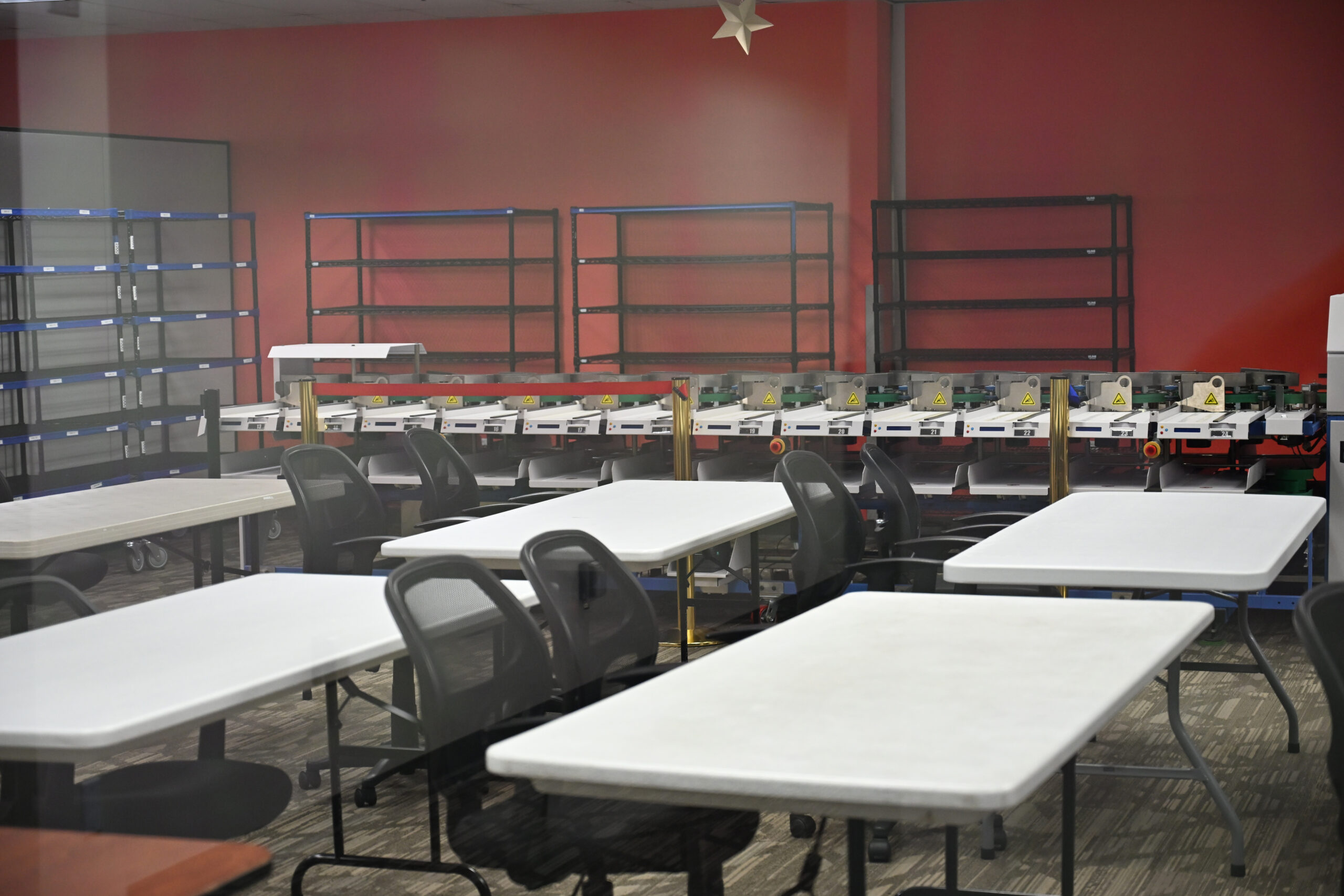
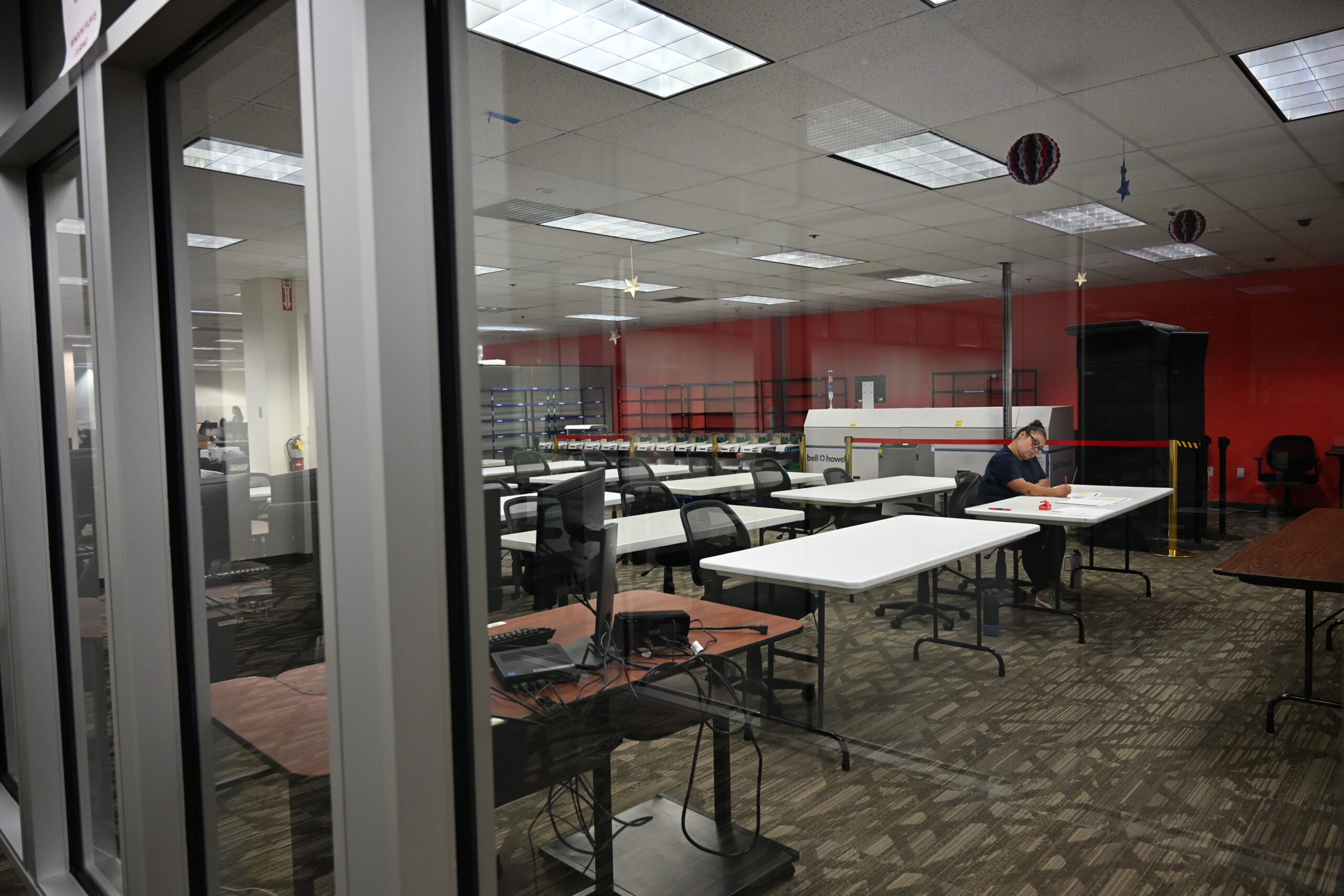
Gina Martinez is Monterey County’s Registrar of Voters. She is in charge of elections. She wants people to watch the elections: There is even a viewing gallery — a lobby with windows — that allows the public to observe the ballot count.
Most importantly, Martinez wants voters to feel confident in the process and integrity of ballot security and election outcomes in Monterey County.
For most of her nearly 20-year career with the county’s election department, Martinez has heard what she calls a constant pendulum swing about election interference, vote rigging and other alleged malfeasance. Lately, there have been unfounded allegations of noncitizens voting. Despite evidence to the contrary, she said, the public perception is worrisome.
“People have no idea of the operations in place to ensure safeguards,” Martinez said of elections in Monterey County and elsewhere. “Misinformation is pervasive. It’s an amazingly complex process. This is the foundation of our country.”
Monterey County officials, including the heads of the local branches of the Democrat and Republican parties, said there are no worries or concerns about election security and voting integrity. Meanwhile, national figures, including President Donald J. Trump and Department of Homeland Security Secretary Markwayne Mullin, are casting doubt, with no evidence, on U.S. — and specifically California — elections. Suspicion is not uncommon across California. In late July, California Assembly Speaker Robert Rivas, whose district includes much of the Central Coast, sued the state because of concerns that Proposition 39 bills itself as election security, when in fact it would present new barriers for registered voters.
Federal agencies, policy organizations and think tanks have concluded that noncitizen voting is not a widespread problem in the United States.
Noncitizen voting ‘virtually nonexistent.’
Federal law prohibits noncitizens from voting; it’s a crime punishable by prison. Voter registration and voting is strictly regulated in cooperation between federal and state governments.
“The evidence is clear that these laws are working as intended — it is extremely uncommon for noncitizens to vote in federal elections,” former director of U.S. Citizenship and Immigration Services in the Department of Homeland Security, Ur Jaddou, wrote in a 2024 letter.
Federal agencies, policy organizations and think tanks have concluded that noncitizen voting is not a widespread problem in the United States. The Brennan Center called noncitizen voting “exceedingly rare.” The libertarian Cato organization called noncitizen voting “virtually nonexistent.” The conservative Heritage Foundation identified only 99 cases of suspected noncitizen voting in the past 26 years.
“The vast majority of allegations of noncitizen registration or voting appear to arise from misunderstandings, mischaracterizations, or outright fabrications about complex voter data,” according to the non-partisan Center for Election Innovation and Research.
Enlarge
Controversy across California
Voting security is complicated, but successful, Martinez explained.
“The security of the process is embedded in the election process and that is state and federal law,” Martinez said.
Local officials share her outlook.
Greg Fuller, the chair of the Monterey County Republican Party, said he works “hand in glove” with the Monterey County Registrar. The county’s Republican Party uses voter rolls to walk precincts and reach out to voters, Fuller explained.
“I am fully impressed with the integrity of Monterey County Elections,” Fuller said when asked if there were concerns with election security.
He did raise two concerns, but noted they were largely bureaucratic: removal of deceased voters from the rolls, as well as residents who no longer live in Monterey County.
Federal and state law strictly dictates the voter registration process, Martinez explained. To ensure voters are not incorrectly removed from voter rolls, the county registrar must send the deceased person a pre-cancellation notice, she said. For many grieving families, that notice can be painful — something she experienced herself — but it ensures the right people are removed from voter rolls following a death.
“I am fully impressed with the integrity of Monterey County Elections." Greg Fuller, chair, Monterey County Republican Party
In a county like Monterey, there are actually many voters who have moved temporarily — like college students, expats and residents with other homes — but are registered in Monterey County, Martinez said, and able to vote in local elections. Movement does not disqualify a voter, she explained, but instead triggers a complex communication process between states, counties and the United States Postal Service. That ensures Monterey County residents can still vote in their local elections, she said.
Seaside Mayor and current chair of the Monterey County Democratic Party Ian Oglesby said he has no concerns about election security. He noted that inquiries about elections are managed and handled locally.
Monterey County Supervisor Wendy Root Askew is an active member of both the California State Association of Counties and the National Association of Counties, organizations that represent regional governments. Root Askew said election protection and integrity is often discussed with those organizations.
“I have a great degree of confidence in the integrity of elections in the state of California,” she said. “Any narrative that questions election security only serves to detract people from voting. That, itself, is a threat to democracy.”
That confidence is not shared across California. Three sitting congressional representatives from the state — Jay Obernolte, Ken Calvert and Darrell Issa — voted against certifying the results of the 2020 presidential election. Rep. Tom McClintock signed a letter that questioned the validity of that election.
“Any narrative that questions election security only serves to detract people from voting. That, itself, is a threat to democracy.”
Monterey County Supervisor Wendy Root Askew
Republican gubernatorial candidate and Riverside County Sheriff Chad Bianco seized 650,000 ballots in Riverside County this past March after alleging ballot discrepancies in the 2025 redistricting special election. State Attorney General Rob Bonta has sued to stop Bianco, who has since returned the ballots.
In June, more than 29,000 Shasta County voters — approximately 55 percent — approved a local amendment that would change voting regulations, including doing away with most mail-in ballots and requiring voters to present government identification at their polling place. Bonta and Secretary of State Shirley Weber have filed suit to stop the amendment. In early August, a judge sided with the state against the Shasta County rule change.
This November, California voters will decide Proposition 39, which would amend the state’s constitution and institute changes similar to some of those proposed — and now on hold — in Shasta County. The ballot initiative was led by San Diego Republican Assembly member Carl DeMaio. The measure enjoys some support among state voters, who otherwise believe elections are secure, according to a UC Berkeley study. However, support dropped after those polled were given more background about the measure and learned it would actually create new barriers to voting.
On July 29, California Assembly Speaker and Salinas representative Robert Rivas, together with Senate President Monique Limón, filed suit against the secretary of state to block the description of Proposition 39 in the ballot summary sent to California voters. The suit alleges the state-published description is false and misleading. In early August, a Sacramento Superior Court judge agreed, ruling the Prop. 39 language would not make voting easier and would make voting less private and less secure.
Enlarge
ICE agents at the polls?
Suspicion around elections has been a dominant part of national politics for the past six years, ever since President Trump claimed he won the 2020 presidential election. Trump has since repeated what has become known as the “Big Lie.” No evidence has been provided to support his claims, but he has used the Big Lie to repeat allegations of fraud by noncitizen voters. The Big Lie prompted the Safeguard American Voter Eligibility Act, or SAVE America Act, which has been introduced but so far has not passed Congress. Trump returned to both the Big Lie and the SAVE America Act in a nationally televised speech on July 16.
The following day, Mullin alleged, with no evidence, that more than 250,000 noncitizens voted in four states, including California. A letter had been sent to Secretary of State Weber, according to Mullin’s press release, demanding a response in two weeks. The statement concluded that Immigration and Customs Enforcement agents have been tasked with deporting undocumented people who vote.
“That level of interference — ICE agents at the polls — would not only be unprecedented, but cause a direct conflict between the state government and federal government. It’s not something to be taken lightly,” said Mindy Romero, executive director of the Center for Inclusive Democracy, a nonpartisan research center that examines voting and civic engagement.
“I think you have to take it seriously, plan for the worse, but at the same time, recognize that California elections are indeed free and fair, and run appropriately to the law. And — this is important — there are a lot of protections against interference in elections.”
“You can have a policy conversation around voter ID and what is appropriate without taking a step that can disenfranchise voters. But what we’re seeing now is voter ID being positioned as a solution to a problem that doesn’t exist.” Mindy Romero, executive director of the Center for Inclusive Democracy
Even after his victory in 2016, Trump claimed, with no evidence, that millions of noncitizens illegally voted, Romero noted. But the constant allegations coming from one of the most influential people on the planet has elevated election fraud claims that were once considered fringe, and helped get a measure like Proposition 39 on the ballot, she said. The proposition’s very inclusion, in turn, can reinforce unfounded claims of illegal voting.
“You can have a policy conversation around voter ID and what is appropriate without taking a step that can disenfranchise voters,” Romero said. “But what we’re seeing now is voter ID being positioned as a solution to a problem that doesn’t exist.”
When asked about claims by Trump and Mullin about California, Martinez said she would follow whatever rules come out of dialogue between the federal and state government. She noted federal election monitors have observed elections before, and that it is not uncommon.
To date, “there is no indication of immigration agents being present or assigned,” she added.
Voters with concerns are encouraged to contact the Monterey County Elections Department, Martinez said. There are multiple options voters can choose, including voting early, voting by mail or visiting their polling place.
Meanwhile, Martinez encourages voters to visit the viewing gallery and watch for themselves the step-by-step mechanics of receiving and counting votes.
Enlarge


Have something to say about this story? Send us a letter.
SUPPORT NONPROFIT JOURNALISM 
GET OUR FREE NEWSLETTER