INVESTIGATIONS |
Read all of Voices’ reporting on ICE detentions at Fort Hunter Liggett here.
By George B. Sánchez-Tello
 Despite carefully worded denials from military officials, Immigration and Customs Enforcement agents have secretly detained individuals following presumed traffic stops by Fort Hunter Liggett Police, leading to at least eleven deportations since late December, Voices of Monterey Bay has found.
But soon after Voices published the narrative of a young woman followed by Fort Hunter Liggett Police on Jolon Road, officers were ordered to discontinue the traffic stops, according to individuals not authorized to speak on the record.
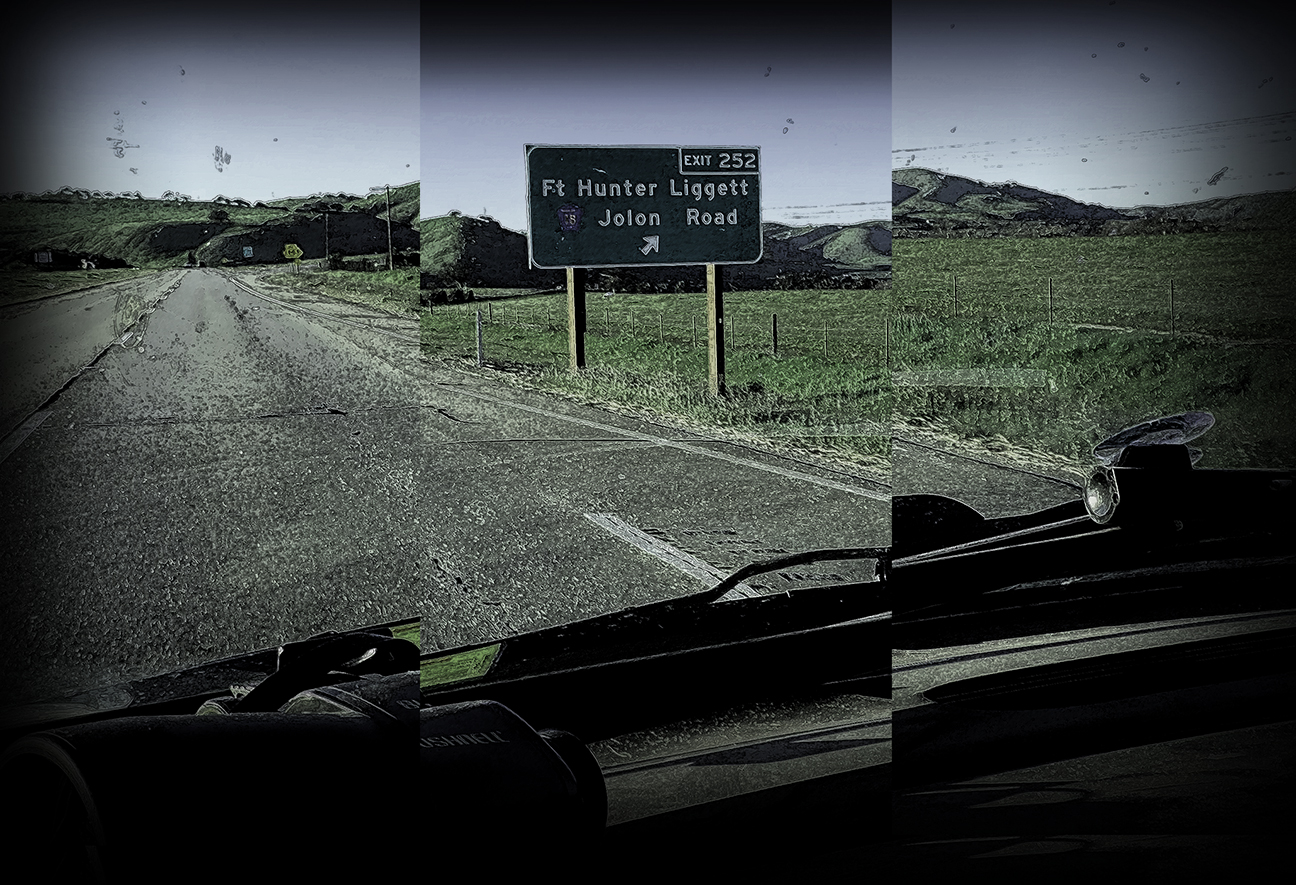
At least six people were detained on Jolon Road, a rural and isolated route that traverses county and federal land between King City, Fort Hunter Liggett and popular outdoor destinations like Lake San Antonio and Lake Nacimiento. One of those detained said six or seven fishermen were kept overnight on or about January 16 in a detention cell on Fort Hunter Liggett before being deported.
The so-called “d-cell” is meant exclusively for members of the military, according to sources who spoke to Voices.
Monterey County, state and federal elected officials are now trying to determine the extent of the Fort Hunter Liggett Police Department’s relationship with Immigration and Customs Enforcement’s San Francisco Field Office.
That office’s agents were on the base, according to people familiar with the operations who spoke to a Voices reporter. The individuals asked not to be named because they were not authorized to speak on the record. They confirmed that ICE agents did detain individuals after traffic stops on Jolon Road and said multiple people have been held in a cell meant only for military personnel.
Attorneys and local law enforcement officials have expressed concern that the federal civilian police stops were simply pretexts for immigration enforcement. Immigrant advocates say the Jolon Road traffic stops appear to be part of the Trump administration’s attempt to militarize detention operations across the country.
However, Fort Hunter Liggett Police have now been ordered to stop traffic enforcement on Jolon Road as a result of local reporting and inquiries from elected officials, according to the sources.
“The use of military lawyers, and invocation of privilege that comes with that, helps to enable that secrecy.” Frank Rosenblatt, retired Lieutenant Colonel, U.S. Army JAG
The Fort Hunter Liggett Police Department is considered federal civilian law enforcement — known as Department of the Army Civilian Police — whose job descriptions include crime prevention, traffic control, criminal investigations, community service, hunting and fishing enforcement, and the protection of archaeological sites and artifacts. Its jurisdiction includes Fort Hunter Liggett’s cantonment — its fenced-in base — as well as wilderness areas and public roads. Fort Hunter Liggett Police also provides law enforcement approximately 150 miles north at Parks Reserve Forces Training Area in Dublin, California.
Fort Hunter Liggett is the largest U.S. Army Reserve training reservation, with up to 110,000 acres of its 165,000 acreage open to the public on weekends and holidays for camping, hunting and fishing. Isolated in a rural section of Southern Monterey County, the Army Reserve installation is adjacent to the Santa Lucia Mountains, the Salinas Valley, Los Padres National Forest and the southern border of Monterey County.
Multiple people, including attorneys, law enforcement and U.S. citizens contacted Voices to confirm immigration officers’ presence at the base in South Monterey County, but would not speak on the record, citing privacy and safety concerns for themselves and their families.
County warns residents about federal lands
The pattern of traffic stops for minor infractions, like broken tail lights or turn signals, followed by the appearance of immigration agents within minutes despite being roughly 20 miles from the closest town — King City — has prompted warnings from immigrant advocates and county officials alike.
On Monday, February 2, Monterey County Communications Bureau released a public information notice entitled “Know Before You Go: Federal Lands in Monterey County,” days after Voices reported on the detentions.
The announcement doesn’t mention the string of Jolon Road traffic stops and immigration detentions. The road is a concurrent jurisdiction, meaning both federal and local law enforcement have authority there.
“Monterey County is home to many beautiful outdoor areas. Some of these lands are managed by the federal government, not by Monterey County,” states the email. “We want residents and visitors to understand what this means for safety, law enforcement, and the rules that apply.”
The email includes a list of approximately 20 federal locations that fall under federal law, including national parks, national forests and Fort Hunter Liggett.
One bullet point recommends “avoiding these areas entirely.”
Military legal experts weigh in
At least two retired military attorneys — members of the Judge Advocate General Corp, or JAG — have said the traffic stops raise concerns about equal protection, the right against search and seizure as well as the Posse Comitatus Act of 1878, which prohibits the Army from enforcing domestic law.
“It is important for the public to know anything involving the military does involve, potentially, layers of secrecy,” explained Frank Rosenblatt, retired Lieutenant Colonel, U.S. Army JAG and an associate professor at the Mississippi College School of Law. Rosenblatt is president of the National Institute of Military Justice.
“The use of military lawyers, and invocation of privilege that comes with that, helps to enable that secrecy.”
Fort Hunter Liggett Police are not a military police force, which are made up of active-duty reserves and National Guard soldiers. As civilian law enforcement, Fort Hunter Liggett Police are initiating the stops that led to federal immigration detentions.
“Using reasonable suspicion of a traffic violation as a loophole to screen for undocumented immigrants — it’s an unfortunate abuse of current constitutional law, but lawful under the Fourth Amendment,” said U.S. Air Force retired Lieutenant Colonel Rachel E. VanLandingham, an associate dean for research at Southwestern Law School. “It’s so easy to exploit, because traffic stops are so easy to do. If you are driving, you will give law enforcement a valid, lawful reason to pull you over eventually. Traffic stops shouldn’t be used for pretextual immigration stops, but the way constitutional law currently is, it allows for such gross abuse.”
But a federal law dating from 1878 prohibits using federal military personnel for domestic law enforcement.
“The statutory overlay of the Posse Comitatus Act would make these pretextual stops unlawful, even if the Fourth Amendment does not,” VanLandingham said. “The illegality is squarely on the Posse Comitatus Act. DOD’s own regulations expressly prohibit such subterfuge.”
Federal civilian law enforcement is not barred from providing logistical support for federal operations, including immigration, VanLandingham added. This includes anything from shared desk space, to holding someone in a military cell or giving logistical support.
“It’s so easy to exploit, because traffic stops are so easy to do.” U.S. Air Force retired Lieutenant Colonel Rachel E. VanLandingham
The pattern described by those stopped, including at least one U.S. citizen, as well as those detained, is also concerning. VanLandingham said there is a legitimate question regarding which traffic regulations Fort Hunter Liggett Police are enforcing.
“They don’t have to trail someone for a mile to find a swerve for a reasonable basis for a DUI. They’re doing this willingly,” VanLandingham said. “Is this a junior, a copycat Bovino-type?”
Greg Bovino is a U.S. Customs and Border Patrol agent who initiated a week-long immigration sweep in Kern County in early 2025 during the final weeks of the Biden Administration. At the time, Bovino’s efforts were dismissed as those of a rogue agent, but he emerged as one of the lead agents for the Trump administration raids of immigrant communities.
Hegseth calls for DOD civilian staff to assist ICE
Civilians working within the Department of Defense, like Fort Hunter Liggett Police, were the audience of a summer missive from Secretary of Defense Pete Hegseth announcing the creation of a “volunteer force” within the military to work with immigration officials.
“The Department of Homeland Security (DHS) Volunteer Force (VF) provides Department of War civilian employees an opportunity to support Immigration and Customs Enforcement (ICE) and Customs and Border Protection (CBP) in their commitment to ensuring a safe and orderly immigration system,” states the recruitment announcement.
The force assists ICE and Border Patrol agents with data entry, operational planning support, processing and logistical support. But it would do this work at ICE and Border Patrol facilities, according to the announcement — which is different from what has occurred at Fort Hunter Liggett.
“We know Defense Secretary Hegseth has wanted to go in this direction for a while,” Rosenblatt said. “But there needs to be proper authority for this. Military police cannot decide on their own to designate military holding facilities for migrants in support of immigration enforcement.”
“If the military is in control of migrants, it needs to be within the law,” Rosenblatt added. “If this has happened, it is incumbent on the military to show what is their authority for this.”
The Army responds
Asked about Fort Hunter Liggett Police traffic stops leading to immigration detentions, U.S. Army Lieutenant Colonel Shahin Uddin sent an e-mail to Voices from Army headquarters in the Pentagon on February 9: “If during these routine patrols, our civilian law enforcement personnel encounter a situation outside of our mission, we may hand that over to the appropriate agency,” Uddin conceded.
But he disputed some details of Voices’ reporting, stating: “The Department of the Army Civilian police at Fort Hunter Liggett neither detained nor held undocumented residents in FHL d-cells.”
Uddin wrote that ICE is not “operating out of” Fort Hunter Liggett and referred Voices to ICE Media Affairs in Denver, Colorado, which did not respond to requests for information.
“If the military is in control of migrants, it needs to be within the law. If this has happened, it is incumbent on the military to show what is their authority for this.” Frank Rosenblatt, retired Lieutenant Colonel, U.S. Army JAG
Questions to Fort Hunter Liggett Garrison Commander Colonel Jason R. McKenzie regarding base police officers and ICE were directed to U.S. Army Public Affairs.
“It is important to note that the Department of Homeland Security (DHS) does not operate at Fort Hunter Liggett,” said Amy Phillips of U.S. Army Public Affairs, in a carefully worded email on February 6. “FHL does not conduct Immigration and Customs Enforcement (ICE) operations, nor do we have the authority to comment on their activities.”
ICE’s San Francisco Field Office, whose areas of responsibility include Northern California, Hawaii, Guam and Saipan, has not responded to emailed requests for comment.
Detention cells on base
The Fort Hunter Liggett Police Department falls under the directorate of emergency services, whose building includes holding cells— the d-cells meant only for active military members — and rooms large enough to detain up to 20 individuals.
One deportee has described being held in a d-cell. Francisco Galicia has shared with Voices — and publicly on social media — that he was pulled over on Jolon Road because a license plate light wasn’t working, detained and held overnight in a cell on the base. He was “processed” in Morgan Hill, then held in Stockton and Bakersfield before being deported to Tijuana, Mexico.
@fracisco.galicia Información importante. Para toda la raza pescadora y pues la persona. Que corren por esa área en general.##fyp ♬ sonido original – Fracisco Galicia
@fracisco.galiciaCómo me deportaron cuando me detuvo un oficial de la base militar en una carretera pública, pero me dijo que era zona federal. Y me entregó con ICE♬ sonido original – Fracisco Galicia
The lack of transparency by the Department of Homeland Security, Immigration and Customs Enforcement and U.S. Army Reserves has prompted Voices and Monterey County NOW to file U.S. Freedom of Information Act requests.
“There has to be a paper trail whenever military organizations are involved with providing their facilities to other organizations, whether non-military, like the Boy Scouts or other federal entities like immigration enforcement,” Rosenblatt said.
“This would have to have been approved by the garrison commander, with input from the staff judge advocate.”
Congress members get involved
Meanwhile, U.S. Reps. Zoe Lofgren and Jimmy Panetta — a U.S. Navy Reserve veteran who earned a Bronze Star in Afghanistan — sent a letter Thursday to Homeland Security Secretary Kristi Noem and U.S. Army Secretary Daniel Driscoll about DHS activity on or near Fort Hunter Liggett, as well as any coordination between both departments and Fort Hunter Liggett.
“These stops appear to have exceeded routine traffic or public safety enforcement and instead served immigration enforcement purposes.” U.S. Reps. Zoe Lofgren and Jimmy Panetta
The letter, dated Feb. 12 and obtained by Voices, states: “We have received multiple, consistent reports indicating that FHL police have conducted roadside stops along Jolon Road and coordinated with Immigration and Customs Enforcement (ICE) in a manner suggesting racial profiling.
“These stops appear to have exceeded routine traffic or public safety enforcement and instead served immigration enforcement purposes. Local officials in Monterey County report they were not notified in advance of these operations.
“The proximity of these activities to a major U.S. Army installation raises serious questions regarding jurisdiction, interagency coordination, statutory authority, and the protection of civil liberties, particularly given the surrounding rural communities with significant immigrant populations.”
The letter asks nine questions around two specific themes: Does the Department of Homeland Security have plans to utilize Fort Hunter Liggett? And whether any police officers patrolling Jolan Road, either civilian or military, are “operating in an immigration enforcement capacity?”
Reps Lofgren and Panetta asked for a response by Feb. 27.
Claudia Meléndez Salinas and Royal Calkins contributed to this story.
FEATURED IMAGE |
Enlarge

Have something to say about this story? Send us a letter.
SUPPORT NONPROFIT JOURNALISM 
GET OUR FREE NEWSLETTER